
Mortgage Rates Average 5.10%

Mortgage Rates Average 5.10%

The 30-year fixed-rate mortgage barely budged this week, but it’s still stressing home shoppers feeling concern about being priced out. The 30-year fixed-rate mortgage averaged 5.10%, down slightly from 5.11% last week, Freddie Mac reports.

But it is one week before the Federal Reserve is expected to raise interest rates further, Nadia Evangelou, National Association of REALTORS® senior economist and director of forecasting, says on the association’s blog. The Fed’s key rate does not have a direct impact on mortgage rates but it does often influence them.

Borrowers may be getting nervous about how high rates could go. Higher rates already are forcing them to increase their budgets. Current buyers need to spend about $25,000 more to buy a comparable home this year than a year ago, Evangelou says.

“The combination of swift home price growth and the fastest mortgage rate increase in over 40 years is finally affecting purchase demand,” says Sam Khater, Freddie Mac’s chief economist. “Home buyers navigating the current environment are coping in a variety of ways, including switching to adjustable-rate mortgages, moving away from expensive coastal cities, and looking to more affordable suburbs. We expect the decline in demand to soften home price growth to a more sustainable pace later this year.

NAR has predicted a 10% drop in home sales for 2022.

Still, while panic continues over higher mortgages, economists note that rates remain lower than historical averages. In 2002, the average rate on a 30-year fixed-rate mortgage was about 7%, which is much higher than this week’s average of 5.10%.

Freddie Mac reports the following national averages with mortgage rates for the week ending April 28:

  • 30-year fixed-rate mortgages: averaged 5.10%, with an average 0.8 point, falling from last week’s 5.11% average. Last year at this time, 30-year rates averaged 2.98%.
  • 15-year fixed-rate mortgages: averaged 4.40%, with an average 0.9 point, increasing from last week’s 4.38% average. A year ago, 15-year rates averaged 2.31%.
  • 5-year hybrid adjustable-rate mortgages: averaged 3.78%, with an average 0.3 point, increasing from last week’s 3.75% average. A year ago, 5-year ARMs averaged 2.64%.

Freddie Mac reports commitment rates along with average points to better reflect the total upfront costs of obtaining a mortgage. Source: Freddie Mac and “Instant Reaction: Mortgage Rates, April 28, 2022,” National Association of REALTORS® Economists’ Outlook blog

©National Association of REALTORS®
Reprinted with permission

Real Estate Companies Posting the Most Growth

Real Estate Companies Posting the Most Growth

Real estate companies are banding together and creating giants in the business that are commanding even more of the market share. The U.S.’s 1,000 largest brokerages accounted for 59.2% of the sales volume in 2022, up from 48.2% in 2019, according to a new report from T3 Sixty, a real estate management consulting and analytics firm.

The nation’s 10 largest brokerages alone commanded 23.6% of sales volume in 2021, up from 18.8% in 2020, shows T3 Sixty’s 2022 Mega 1000 report. The Mega 1000 report ranks the nation’s 1,000 largest brokerages by sales volume, transaction sides, and agent count.

Brokerage Increased Agent Count By 50% in 1 Year

Compass topped the list and achieved the largest growth over the past year. Compass moved up from number three on the list in 2021 to the number one spot for 2022. eXp Realty also posted significant growth in its sales volume, jumping by 116.2% from 2020 to 2021. It landed at number four on this year’s rankings.

A table showing the change in sales volume and transaction sides from 2018 to 2021

Source: “2022 Mega 1000,” T3 Sixty (April 28, 2022)

©National Association of REALTORS®
Reprinted with permission
Demand Doubles for ARMs

Demand Doubles for ARMs

The share of mortgage applications with adjustable-rate mortgages doubled last week when compared to three months ago, the Mortgage Bankers Association reported Wednesday. ARMs, which start at one rate and then fluctuate after a set period, comprised more than 9% of loans and 17% of the dollar volume.

ARMs were blamed for contributing to the housing bubble of the mid-2000s, offering teaser low rates to borrowers that, once they reset, led to some homeowners no longer being able to afford their mortgage. Lenders say they’re stricter about who qualifies for ARMs nowadays.

The latest lower introductory rates from ARMs may grow more enticing as home buyers watch other rates quickly climb. The average contract interest rate for the 30-year fixed-rate mortgage with conforming loan balances ($647,200 or less) rose to 5.37% last week. That is up from 3.17% just a year ago, the Mortgage Bankers Association reports. The average rate on a 5-year ARM, however, was 4.28% last week.

The doubled share of ARM applications compared to three months ago coincides with the 1.5 percentage point increase in the 30-year fixed rate, says Joel Kan, an MBA economist.

“As buyers continue to navigate today’s housing market and rising interest rates, many are considering adjustable-rate mortgages,” says Glenn Brunker, president of Ally Home. “ARMs can help buyers save money over a fixed rate because they often offer a lower monthly mortgage payment for the initial period of the loan, typically 5, 7, or 10 years.”

When determining whether to choose a fixed or ARM mortgage, borrowers likely will want to make two main considerations, Brunker says: How long they’ll be in the home and their personal finances and affordability. “The interest rate on a fixed-rate mortgage is locked in for the life of the loan—whether it’s 15, 20, or 30 years,” he says. “So if a buyer is planning to stay in their home for an extended period of time, the peace of mind that comes with a fixed-rate mortgage is beneficial.”

Also, he notes that ARM loans may increase if interest rates rise further when they do reach that adjustable reset period. But there is some protection offered on ARMs based on periodic and lifetime caps on interest rate increases, which borrowers can look into before they commit. Source: “Adjustable-Rate Mortgage Demand Doubles as Interest Rates Hit the Highest Since 2009,” CNBC (April 27, 2022) and Ally Home

©National Association of REALTORS®
Reprinted with permission
Is a Calmer Market Coming?

Is a Calmer Market Coming?

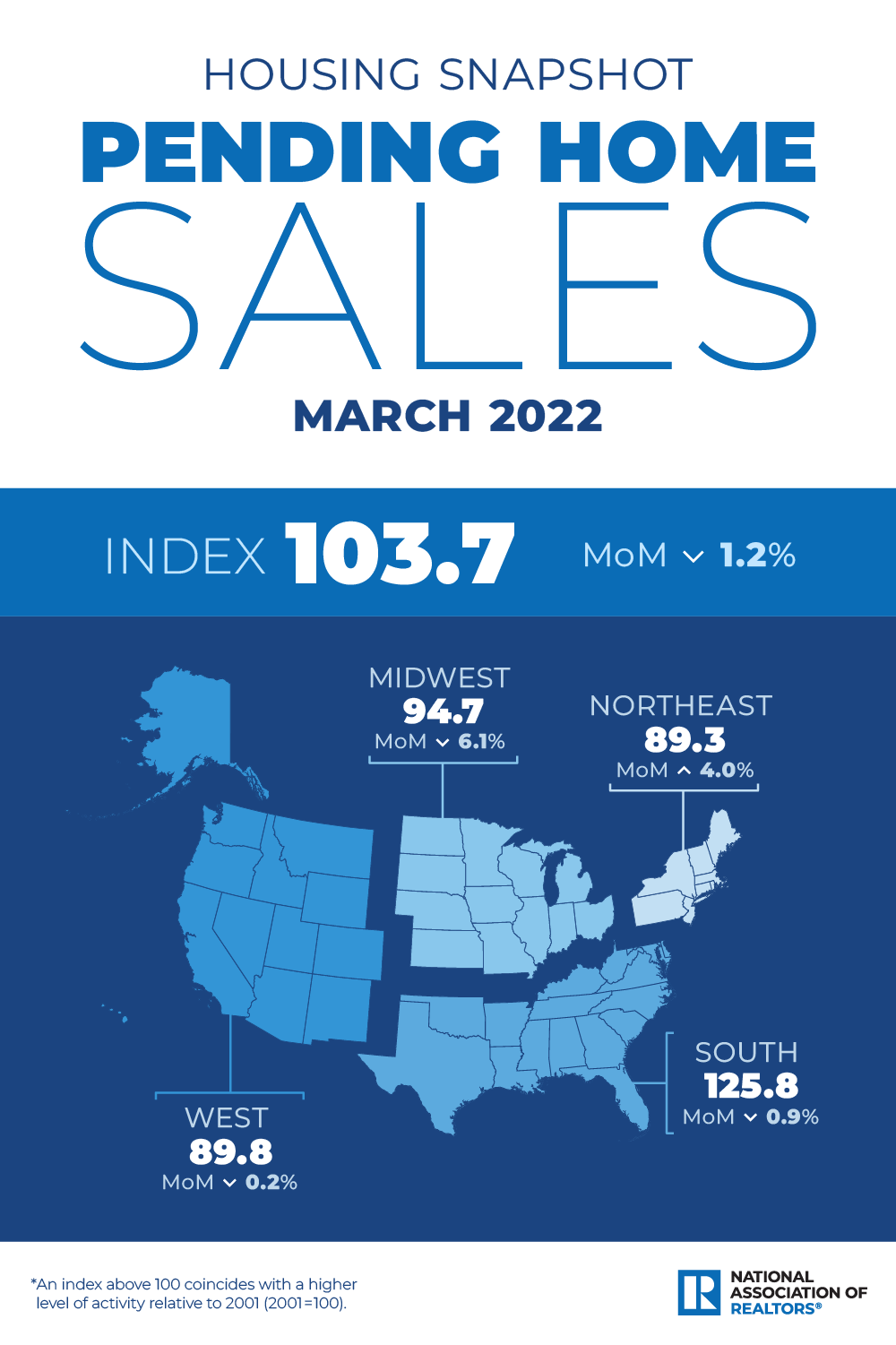
The housing market is showing some early signs of normalizing. Contract signings dropped in March, the fifth consecutive month that pending home sales have fallen, the National Association of REALTORS® reported Wednesday. The Northeast was the only major region of the U.S. that saw a monthly increase in contract signings. All other regions dropped.

“The falling contract signings are implying that multiple offers will soon dissipate and be replaced by much calmer and normalized market conditions,” says Lawrence Yun, NAR’s chief economist. “As it stands, the sudden large gains in mortgage rates have reduced the pool of eligible home buyers, and that has consequently lowered buying activity. The aspiration to purchase a home remains, but the financial capacity has become a major limiting factor.”

NAR’s Pending Home Sales Index, a forward-looking indicator of home sales based on contract signings, dropped 1.2% in March to a reading of 103.7. (An index of 100 is equal to the level of contract activity in 2001.) Overall, contract signings fell 8.2% year over year in March.

The drop comes at a time when inflation is running at a 40-year high and living costs are rising. (Read more: Inflation Edges Higher, Affecting Housing.) Yun expects inflation to average 8.2% in 2022. He predicts that it will start to moderate, however, to 5.5% in the second half of the year.

Home buyers are also facing higher borrowing costs. Yun predicts the 30-year fixed-rate mortgage to average 5.3% by the fourth quarter of this year. He expects rates to average 5.4% by 2023.

Higher mortgage rates and sustained price appreciation has led to a year-over-year increase of 31% in mortgage payments in March, according to NAR’s data.

“Overall existing-home sales this year look to be down 9% from the heated pace of last year,” Yun says. “Home prices are in no danger of decline on a nationwide basis, but the price gains will steadily decelerate such that the median home price in 2022 will likely be up 8% from last year.”

Rental costs are also surging higher. Monthly payments have soared, and Yun predicts more renters will explore homeownership as a result to the higher costs.

“Fast-rising rents will encourage renters to consider buying a home, though higher mortgage rates will present challenges,” Yun says. “Strong rent growth nonetheless will lead to a boom in multifamily housing starts, with more than 20% growth this year.”

A US map chart of pending home sales across the country as of March 2022

Source: National Association of REALTORS®

©National Association of REALTORS®
Reprinted with permission
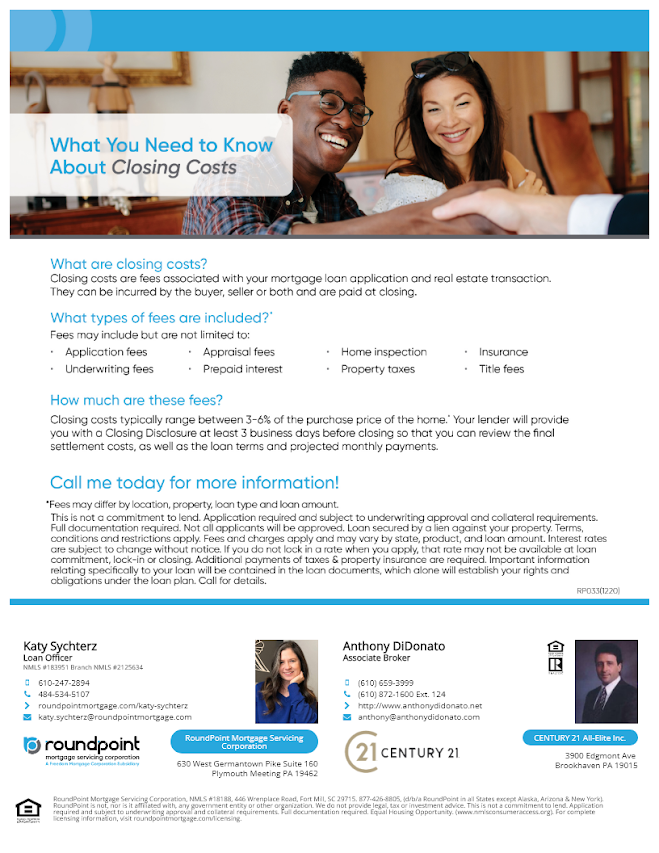
Closing Costs – What you need to know…

What are closing costs? Learn more about closing costs below! With the help of myself and Katy Sychterz of RoundPoint Mortgage, (NMLS# 183951 – 484.534.5107) we can explore homebuying options to help you meet your goals. #RealEstate #Realtor #HomePurchase #BuyersMarket #PlymouthMeetingRP 

More Homes Tout Green Features

More Homes Tout Green Features

Real estate professionals are finding it’s important to become more familiar with the “green” in their housing market as more clients show greater interest and more sustainable properties hold perceptions of being more valuable. Half of more than 2,500 REALTORS® recently surveyed say they’ve recently helped a client buy or sell a home with green features, a significant jump from 32% the previous year, according to the National Association of REALTORS® newly released “2022 REALTORS® and Sustainability Report.”

“Sustainability continues to play a growing role in consumers’ purchasing decisions, and this is becoming even more prevalent in the real estate market,” says NAR President Leslie Rouda Smith. “With the residential property market, in particular, home buyers have expressed increased interest in eco-friendly factors like solar panels and energy efficiency.”

Sixty-three percent of REALTORS® surveyed said that they’ve found promoting energy efficiency in listings was very or somewhat valuable. Fifty-one percent said their clients were very or somewhat interested in sustainability.

These features are increasingly getting promoted in the MLS. About one-third of REALTORS® say that their MLS has green data fields. The MLS fields were used to call out green features, energy information, and green certifications.

“More sustainable homes bring benefits to homeowners like cost savings from energy efficiency, health benefits from improved indoor air quality, and increased comfort and durability from material use and construction, and may also increase resale value,” Lautz says.

Read more: 2022 REALTORS® and Sustainability Report Source: “2022 REALTORS® and Sustainability Report,” National Association of REALTORS® (April 26, 2022)

©National Association of REALTORS®
Reprinted with permission
Home Buyers Are Still Hopeful

Home Buyers Are Still Hopeful

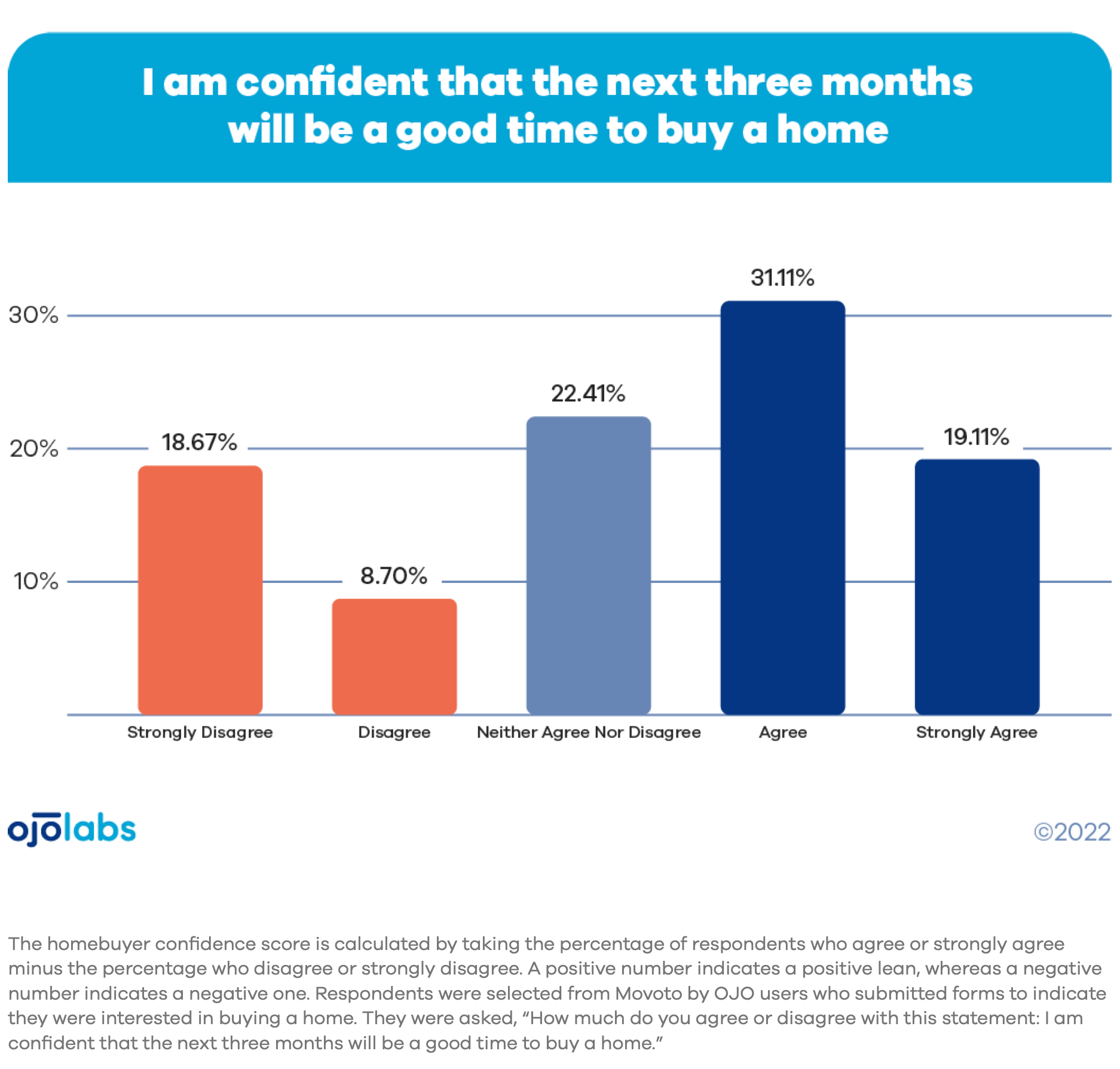
Home prices remain high and mortgage rates are rapidly rising, but home buyers are still hopeful about this spring. A new survey from OJO Labs, a real estate search site, shows that at least half of buyers believe the next three months will be a good time to buy a home.

OJO Labs surveyed consumers who indicated they were interested in learning more about a home between March 15 and April 17 and asked them to rate homebuying conditions over the next three months.

Of the more than 1,500 respondents, 31% agreed with the statement that the next three months would be a good time to buy a home, an increase from 25% last month. The “agree” cohort was the largest OJO Labs has reported since it began tracking the data.

A bar chart showing buy confidence in purchasing a home in the next three months.

Source: “Homebuyer Confidence Rebounds Even as Rates Rise,” OJO Labs (April 21, 2022)

©National Association of REALTORS®
Reprinted with permission
Multiple Offers Remain Prevalent This Spring

Multiple Offers Remain Prevalent This Spring

Home sellers are still fetching multiple offers on their properties and buyers continue to face competition, even as the housing market has shown some signs of slowing.

REALTORS® reported an average of nearly five offers on each home that sold in March, according to the March REALTORS® Confidence Index survey.

On average, half of buyers made two offers before being successful in their purchase by the third try, the survey shows.

Buyers are paying more than list price, too. Fifty-seven percent of buyers offered above the list price, which is up from 48% in February.

“Multi-offers on a home are still prevalent because even if buyer traffic is weakening it is still outpacing supply,” Gay Cororaton, research economist at the National Association of REALTORS®, writes at the association’s Economists’ Outlook blog. “With homebuying demand still outpacing supply, properties typically stayed on the market for a shorter time compared to one year ago, at 17 days on the market.” Eighty-seven percent of listings were on the market for less than one month.

Cash buyers still continue to hold the upper hand in bidding wars, accounting for 28% of sales in March. Buyers who offered an all-cash transaction were four times more likely to win in a competitive offer situation than those who didn’t in 2021, according to a report from Redfin. All-cash offers were found to be significantly more successful than other strategies, such as waiving financing contingencies or pre-inspections. Source: “Multioffer Bidding Still Prevalent Despite Slowing Demand,” National Association of REALTORS® Economists’ Outlook blog (April 22, 2022)

©National Association of REALTORS®
Reprinted with permission
New-Home Projects Jump 47%

New-Home Projects Jump 47%

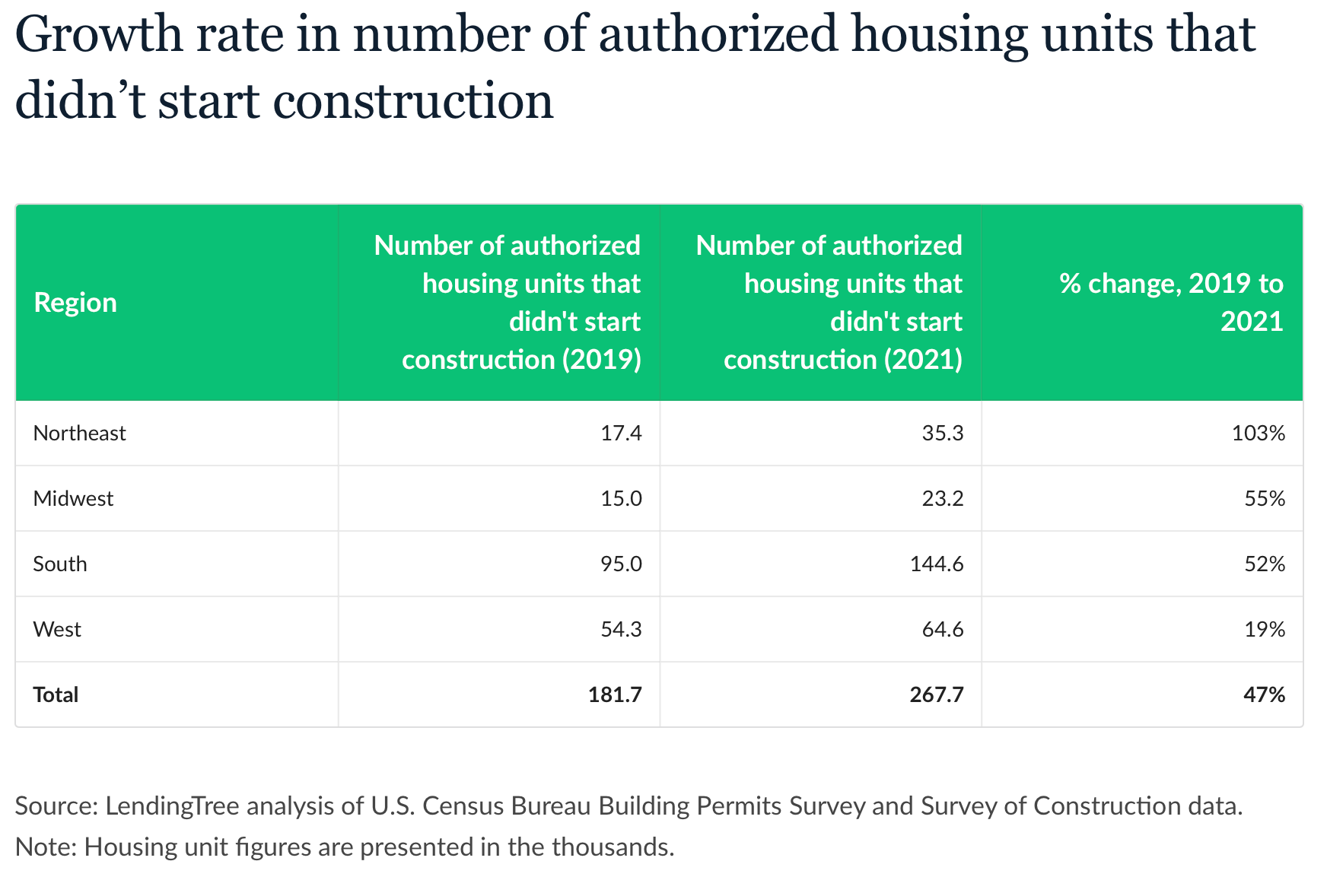
New-home buyers are having a long wait for their homes to be done. Labor shortages and global supply chain bottlenecks are delaying the completion of many new-home construction projects. The number of housing units that were authorized but didn’t start construction yet rose by 47% nationwide from 2019 to 2021, according to a new analysis by LendingTree researchers. The delays were most prominent in the Northeast, where delays more than doubled.

“Though homebuilders have tried to keep up with demand for housing, numerous setbacks including rising labor and raw material costs have prevented them from actually breaking ground on many of the projects,” says Jacob Channel, LendingTree’s senior economic analyst. “This has exacerbated the lack of housing available on the market and put upward pressure on home prices.”

Building Delays, High Prices Slow New-Home Construction

The headwinds are coming at a time when new-home construction has been in demand among home buyers who have been frantic to find greater housing inventory. The number of housing units authorized by building permits jumped 25% from 2019 to 2021, according to LendingTree’s data.

A table charting the growth rate in the number of authorized housing units that didn't start construction.

“Despite these difficulties, the news isn’t all bad for homebuilders,” LendingTree researchers note in the study. “Even if rising mortgage rates weaken buyer demand and labor and supply issues persist, homebuilders will likely have plenty of opportunities to construct and sell new housing units as the year progresses. And though the road ahead may be bumpy, that doesn’t mean it won’t ultimately be rewarding for many of those in the construction business.” Source: “Stalled Construction Projects Up 47% Nationwide Since Pre-Pandemic, Even as Home Constructions Rise,” LendignTree (April 19, 2022)

©National Association of REALTORS®
Reprinted with permission

Foreclosure Activity at New High Since the Pandemic Began

Foreclosure Activity at New High Since the Pandemic Began

Foreclosure starts and bank repossessions are at their highest numbers in the last two years. Most pandemic-initiated moratoriums have lifted by now and lenders are starting to resume foreclosures. Still, foreclosure activity remains well below historical levels.

The number of properties with a foreclosure filing during the first quarter of 2022 climbed 39% compared to the previous quarter. Foreclosure filings are up much higher—132%—compared to a year ago, according to ATTOM Data Solutions’ Q1 2022 U.S. Foreclosure Market Report.

“Foreclosure activity has continued to gradually return to normal levels since the expiration of the government’s moratorium, and the CFPB [Consumer Financial Protection Bureau’s] enhanced mortgage servicing guidelines,” says Rick Sharga, executive vice president of market intelligence for ATTOM. “But even with the large year-over-year increase in foreclosure starts and bank repossessions, foreclosure activity is still only running at about 57% of where it was in Q1 2020, the last quarter before the government enacted consumer protection programs due to the pandemic.”

Foreclosure starts have increased in all 50 states. The states with the largest number of foreclosure starts in the first quarter included California, Florida, Texas, Illinois, and Ohio. Broken out by metro level, the greatest number of foreclosure starts last quarter were in Chicago, New York, Los Angeles, Houston, and Philadelphia.

Nationwide, Sharga says it’s likely that foreclosure activity will continue to see significant month-over-month and year-over-year gains through the second quarter of 2022. “But [we] still won’t reach historically normal levels of foreclosures until the end of the year at the earliest, unless the U.S. economy takes a significant turn for the worse,” he notes. Source: “U.S. Foreclosure Activity Sets Post Pandemic Highs in First Quarter of 2022,” ATTOM Data Solutions (April 20, 2022)

©National Association of REALTORS®
Reprinted with permission

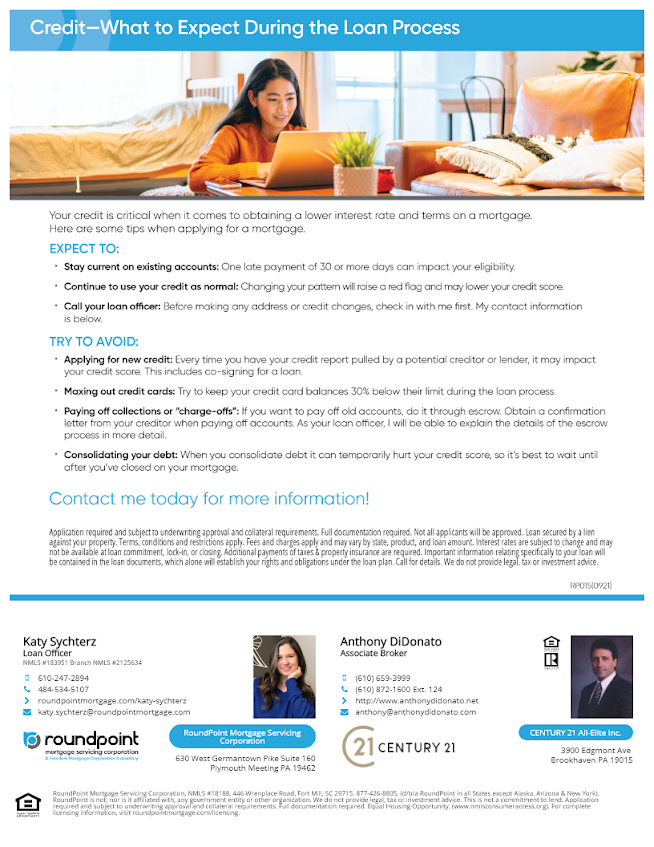
What to expect during the loan process

Having a healthy credit score is important when getting pre-approved! Here is what to expect when applying for a mortgage. With the help of myself and Katy Sychterz of RoundPoint Mortgage, (NMLS# 183951 – 484.534.5107) we can explore homebuying options to help you meet your goals. #RealEstate #Realtor #HomePurchase #BuyersMarket #PlymouthMeetingRP 

Home Buyers’ Top Regrets

Home Buyers’ Top Regrets

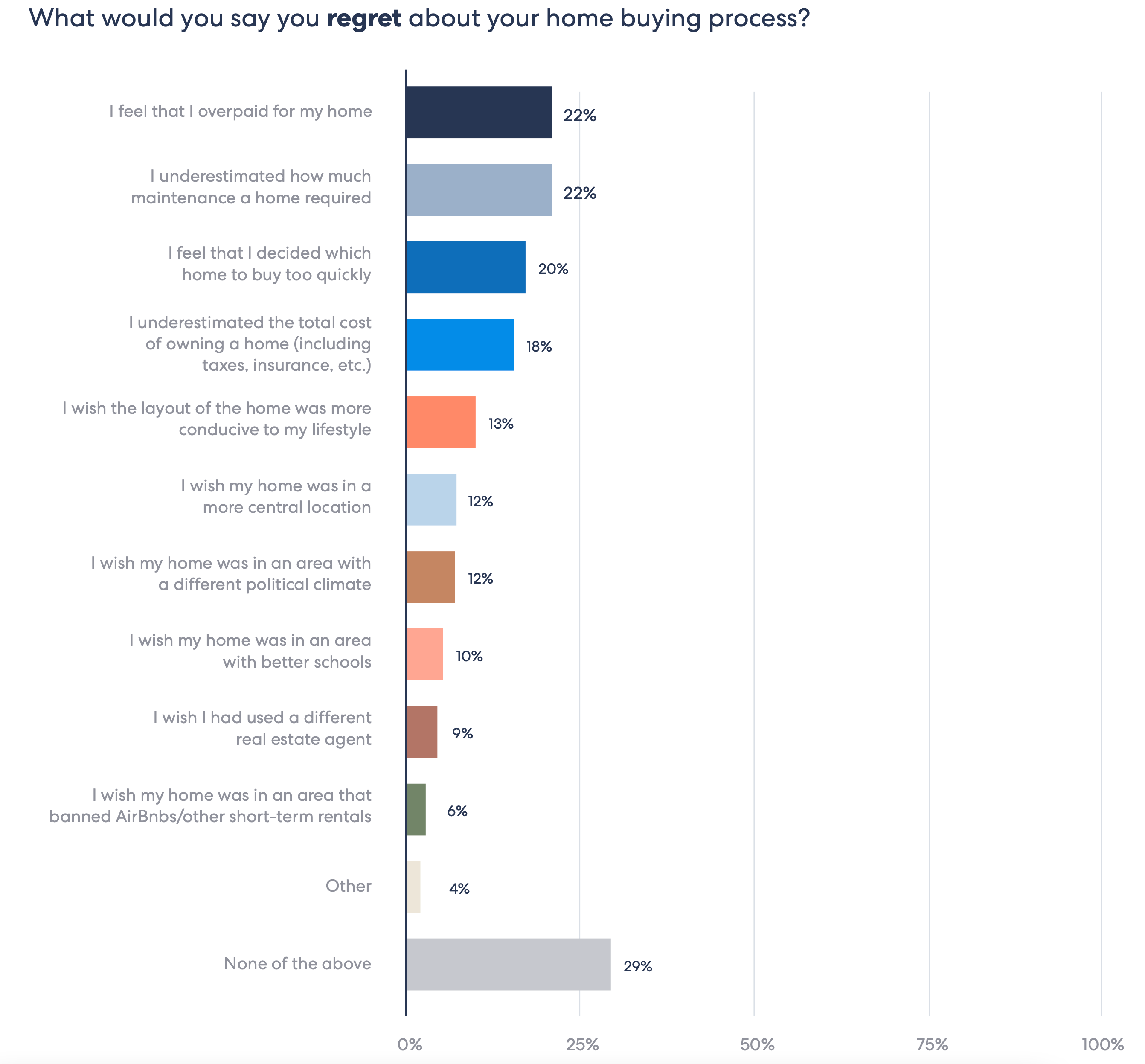
About 70% of buyers recently surveyed say they have at least one regret about their homebuying experience, according to the “Buyer and Seller Insights Report for 2022” conducted by HomeLight, a real estate referral company.

The biggest regrets: What they paid for their home and home maintenance.

Twenty-two percent of buyers surveyed said they felt they overpaid for their home. Twenty-two percent also said they underestimated how much maintenance the home required.

About 18% of buyers surveyed also said they underestimated the total cost of owning a home, including the taxes, insurance, etc., the survey shows.

A bar chart showing the leading instances of regrets buyers have from the homebuying process.

Buyer regret was more common in some locales than others. For example, at least 79% of buyer respondents in Phoenix and several California markets said they had at least one regret, the HomeLight survey shows. In Phoenix, buyers said they wished their home was in a more central location. In the San Francisco Bay Area and Sacramento, Calif., buyers were more likely to say they underestimated how much maintenance a home required. Source: “Buyer and Seller Insights Report for 2022,” HomeLight (2022)

©National Association of REALTORS®
Reprinted with permission