Mortgage Rates Reach Highest Levels Since 2009

Mortgage Rates Reach Highest Levels Since 2009

The 30-year fixed rate mortgage averaged 2.96% just a year ago; this week, it averages 5.27%, Freddie Mac reports.

“Mortgage rates resumed their climb this week as the 30-year fixed reached its highest point since 2009,” said Sam Khater, Freddie Mac’s chief economist. “While housing affordability and inflationary pressures pose challenges for potential buyers, house price growth will continue but is expected to decelerate in the coming months.”

Freddie Mac reported the following national averages for the week ending May 5:

  • 30-year fixed-rate mortgages: averaged 5.27%, with an average 0.9 point, rising from last week’s 5.10% average. A year ago, 30-year rates averaged 2.96%.
  • 15-year fixed-rate mortgages: averaged 4.52%, with an average 0.8 point, increasing from last week’s 4.40% average. A year ago, 15-year rates averaged 2.30%.
  • 5-year adjustable-rate mortgages: averaged 3.96%, with an average 0.2 point, climbing from last week’s 3.78% average. A year ago, 5-year ARMs averaged 2.70%.

Freddie Mac reports commitment rates along with average point to better reflect the total upfront costs of obtaining a mortgage. Source: Freddie Mac

©National Association of REALTORS®
Reprinted with permission

Top 10 Destinations for Out-of-State Movers

Top 10 Destinations for Out-of-State Movers

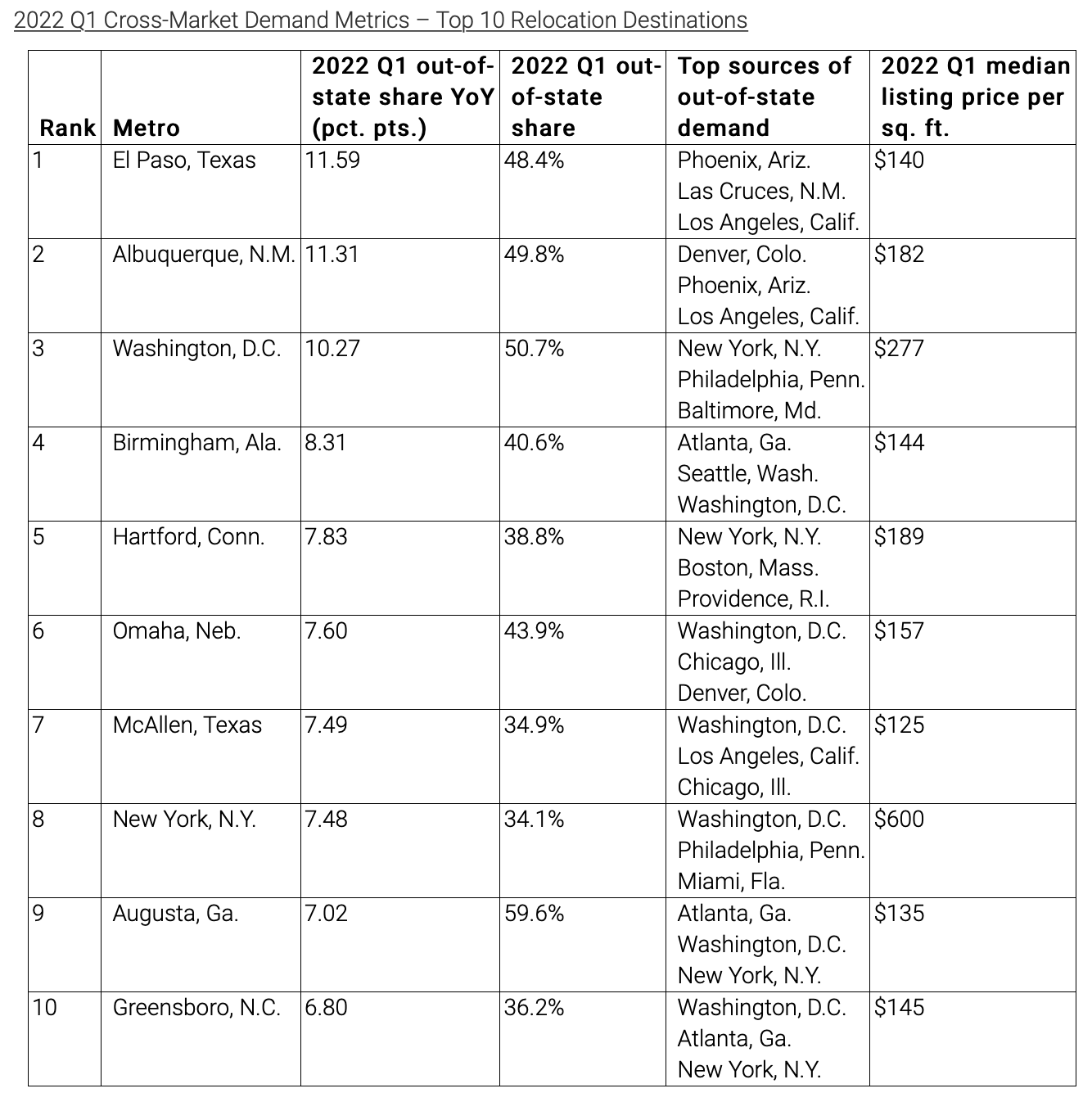
Home shoppers’ interest in relocating to a different state is on the rise, finds a new survey from realtor.com®. During the first quarter, 40.5% of prospective buyers searching for homes for sale on realtor.com® were looking for homes outside of their current state.

“After two years of pandemic remote work, offices have started to reopen, but instead of seeing a slowdown in the number of people interested in homes out of state, we’re seeing an acceleration,” says Danielle Hale, realtor.com®’s chief economist. “Taking a closer look at the top destinations, we see some very different trends driving the desire to live out of state and home shoppers’ diverse needs.”

Affordability remains a key focus for buyers, Hale says. Demand for less expensive areas has increased in recent months due to high inflation and rising mortgage rates. Also, the flexibility from the higher adoption of remote work is fueling greater interest in sunnier climates like the Sun Belt, Hale says. Some buyers also are showing renewed interest in living downtown. Two major metros made realtor.com®’s list of top destinations for out-of-state home shoppers.

The following are the top 10 relocation destinations, according to realtor.com®.

A table showing the top 10 destinations for out-of-state movers.

Source: Move Inc.2 Com

©National Association of REALTORS®
Reprinted with permission

Fed Raises Rate: What It Means for Housing

Fed Raises Rate: What It Means for Housing

The Federal Reserve voted on Wednesday to raise its target short-term federal funds rate by a half-point. That marks the largest increase in the Fed’s rate in more than two decades and suggests higher mortgage rates will follow.

The Fed’s latest action looks to control inflation, which is running at a 40-year high. The federal funds rate, which is set by the central bank, is the interest rate banks use to borrow from and lend to one another. While mortgage rates are not directly tied to the Fed’s rate, they are often influenced by it.

As such, many economists say, mortgage rates will likely continue to keep climbing. Already, they’ve increased nearly 2 percentage points since just the beginning of the year, increasing the cost of monthly mortgage payments by hundreds of dollars. The 30-year fixed-rate mortgage averaged 5.10% last week, its highest level since April 2010, according to Freddie Mac.

After the Fed’s action on Wednesday, consumers likely will see changes to their borrowing and saving rates across the board, including higher credit card rates, car loans, student debt, and mortgages, economists say.

Adjustable-rate mortgages and home equity lines of credit may see the biggest impact initially since they are linked more closely to the prime rate, CNBC reports.

But the 30-year and other mortgage rates likely will still be influenced by the Fed’s actions, economists say. By the end of 2022, 30-year rates could be near 6%, says Jacob Channel, senior economic analyst at LendingTree.

That is still low by historical standards, but for home buyers already facing higher prices for homes, the effect may be to price more buyers out.

Lawrence Yun, NAR’s chief economist, said during a session at the 2022 REALTORS® Legislative Meetings this week in Washington, D.C., that he expects a slowdown in housing from its recent highs. The rapid increase in mortgage rates along with the other effects of inflation are taking a toll.

“Mortgages now, compared to just a few months ago, are costing more money for home buyers,” Yun said. “For a median-priced home, the price difference is $300 to $400 more per month, which is a hefty toll for a working family.”

Yun predicts that inflation will remain high over the next several months and that the market will see further monetary policy tightening through a series of rate hikes. Higher mortgage rates will likely slow the market, Yun says. Source: “Here’s What the Fed’s Half-Point Rate Hike Means for Your Money,” CNBC (May 4, 2022) and “The Fed Raises Interest Rates by 0.50%. How Will This Affect the Housing Market,” Motley Fool (May 4, 2022)

©National Association of REALTORS®
Reprinted with permission

Rainy Days Could Be Best for Home Showings

Rainy Days Could Be Best for Home Showings

Although real estate pros know many buyers may be tempted to cancel a home tour if the weather is nasty weather, they say rainy days are actually the best circumstances to view homes.

Gail Hardy, a real estate pro in Knoxville, talks about the advantages of touring homes on a rainy day in a new TikTok video. She says a rainy day offers the potential to spot any water-related issues outside a home by watching how the water moves around a house.

In her TikTok video, she shows a pool of water next to the home’s foundation. She also shows how a gutter that has been clogged by rocks isn’t doing its job. That gutter could be preventing water from draining away from the house.

A home inspector can look at a home for grading or potential water issues. But a buyer who makes a visual inspection on an inclement day can also flag potential problems.

Buyers can also spot any potential water-related issues inside the house.

“Water is one of the most destructive issues for a homeowner, and it also creates issues that can often be missed,” Craig McCullough, a real estate pro in Washington, D.C., told Apartment Therapy. “Leaks in a ceiling, moisture in a basement, and mildew smells are heightened on a rainy day. If these are new leaks, they may not have developed water stains or dissolved drywall yet.”@gailsellsknoxville Best day to look at houses? #GailSellsKnoxville#homebuyingtips#rainyday#knoxvilletn#knoxvillerealestate#knoxvillehomes#drainage#gutters♬ original sound – Gail Hardy, Knoxville Realtor

7 Home Inspection Myths Source: “Here’s Why a Rainy Day Is the Best Day to Look at a House,” Apartment Therapy (May 3, 2022)

©National Association of REALTORS®
Reprinted with permission

The Impact of High Mortgage Rates

The Impact of High Mortgage Rates

The sharp rise in mortgage rates this year has added hundreds of dollars to new monthly mortgage payments.

In fact, climbing rates have caused the monthly amount of a new mortgage payment to increase by an average of $258.57. That equals an average of an extra $3,102.84 per year and an average of $93,085.20 over the lifetime of a 30-year loan, according to a new LendingTree study that puts a dollar amount on how much rates have affected mortgage costs.

LendingTree calculated the difference between average monthly mortgage payments of a 30-year fixed-rate loan in each state based on average annual percentage rates in January and April 2022. They found that mortgage payments have risen the most in California, Washington, and Massachusetts. Mortgage payments have increased the least in Ohio, West Virginia, and Kentucky, the study finds.

APRs on the 30-year fixed-rate mortgage have jumped by an average of 1.46 percentage points across all 50 states since January, when the average APR was 3.79%. In April, it was 5.25%, according to LendingTree.

“Though mortgage APRs have already significantly increased since the start of the year, they may rise even further by 2023,” says Jacob Channel, LendingTree’s senior economic analyst. “This is especially true given that the Federal Reserve is poised to raise the Fed funds rate multiple times this year—including what is likely to be a 50 basis point hike announced this week—which will likely put even more upward pressure on mortgage rates.”

While mortgage rates are still low by historical standards, home buyers also are facing higher prices for homes. In the first quarter, 70% of the largest metros in the U.S. posted double-digit price growth in median single-family existing-home sales prices, the National Association of REALTORS® reported Tuesday.

Source: “Rising Mortgage Rates Could Cost Some Home Buyers More Than $100,000 Over Lifetime of Loans,” LendingTree (May 3, 2022)

©National Association of REALTORS®
Reprinted with permission
Asian American Homeownership Rates Rebound

Asian American Homeownership Rates Rebound

Homeownership is a big part of the American dream for Asian Americans, according to a new report from realtor.com® that coincides with Asian American & Pacific Islander Heritage Month. Their presence in the real estate market has been rebounding sharply after having decreased during the early stages of the pandemic.

Homeownership rates for Asian Americans were at 61.2% in the fourth quarter of 2021. Home sales have grown the most among millennial and female Asian Americans, outpacing their older or male counterparts, according to realtor.com®’s research.

Asian Americans tend to have higher educational attainment and household income than other racial and ethnic groups. But even as their homeownership rates grow, they may be down from what they could be due to several barriers they face in the housing market. Language barriers in the buying process and the prevalence of multigenerational living—which often comes with higher housing costs—are among the biggest challenges faced by Asian American households, according to a recent study by CAPACD, a coalition of organizations that work with Asian Americans and Pacific Islanders.

Early during the pandemic, Asian American home buyers declined in real estate. But they have since rebounded in the housing market, even more so than other racial groups.

“One potential explanation for the strong rebound is that they have higher motivations to take advantage of the historically low mortgage rates,” notes realtor.com® in its report. Asian American borrowers generally live in expensive metro areas, which could result in higher average loan amounts than their peers. The record low mortgage rates last year may have prompted more Asian American buyers to take advantage of the lower borrowing costs in their markets.

A line graph with two lines, charting Asian-American and non-Asian-American home sales.

Source: “Asian American & Pacific Islander Heritage Month 2022,” realtor.com® (April 29, 2022)

©National Association of REALTORS®
Reprinted with permission

Great Resignation Leads to Real Estate Rush

Great Resignation Leads to Real Estate Rush

Since the pandemic began, a “Great Resignation” has taken root as people left their jobs. Many of them apparently may be shifted careers to real estate.

From January 2021 to January 2022, the top trending career search entry was “how to become a real estate agent,” according to Google searches.

More people have entered a career in real estate between 2020 and 2021, recording a 60% increase compared to the two years prior, The New York Times reports. With the real estate market booming across the country, job hunters may be drawn to the profession and the opportunity to build their own businesses.

“I think many people have gone through the journey over the past number of years now of exploring, I’ll call it self employment, and perhaps the kind of role that is both flexible and knows no boundaries,” Ryan Gorman, CEO of Coldwell Banker Real Estate, told Fortune. “And there is no more boundaryless role than a real estate agent. So we literally have real estate agents—with the same license that anyone can obtain over the next few months—who enjoy an income of seven and even eight figures, because they’ve realized that they can get out of it what they put into it. There is no telling you what the limit is to your potential.”

While the sky may be the limit for a real estate professional’s salary, most agents don’t make six figures, however. The median annual earnings for a real estate sales agent were $48,340 in May 2021, according to the U.S. Bureau of Labor Statistics.

People are being drawn to a career in real estate for better work/life balance, increased income potential, and gratitude for having a job, according to a new Coldwell Banker Real Estate survey of 1,405 licensed real estate agents and brokers.

The National Association of REALTORS®’ latest total membership count, reflecting April data, was at nearly 1.55 million members. The states with the most members are Florida, California, and Texas. Source: “Great Resignation Quitters Are Rushing to Get Real Estate Licenses. Coldwell Banker’s CEO Explains Why That Is, and How He Keeps His Team Happy,” Fortune.com (May 2, 2022)

©National Association of REALTORS®
Reprinted with permission

Start Your New Home Journey

Start Your New Home Journey

Getting pre-approved is crucial first step when searching for your dream home! With the help of myself and Katy Sychterz of RoundPoint Mortgage, (NMLS# 183951 – 484.534.5107) we can explore homebuying options to help you meet your goals. #RealEstate #Realtor #HomePurchase #BuyersMarket #PlymouthMeetingRP 

US Metros See Major Price Appreciation

US Metros See Major Price Appreciation

Homeowners may be shocked by what their home is now worth. In the first quarter, 70% of the largest metros in the U.S. posted double-digit price growth in median single-family existing-home sales prices, the National Association of REALTORS® reported Tuesday.

The median sales price of a single-family existing home rose at a faster pace in the first quarter and was at $368,200, a 15.7% increase from a year ago.

With both prices and mortgage rates rising, housing affordability is worsening for home buyers. Monthly mortgage payments on a typical existing single-family home with a 20% down payment rose to $1,383, an increase of $319 or 30% higher than a year ago. Households are spending 18.7% of their income on mortgage payments, up 14.2% from a year ago, NAR reports in its latest quarterly report.

Will High Prices Last?

“Prices throughout the country have surged for the better part of two years, including in the first quarter of 2022,” says Lawrence Yun, NAR’s chief economist. “Given the extremely low inventory, we’re unlikely to see price declines, but appreciation should slow in the coming months.”

The first quarter registered a record low number of homes for sale. But Yun predicts that home prices will moderate as more housing supply is expected to come onto the market this quarter.

He also believes more buyers will get priced out of the market due to the higher mortgage rates. The 30-year fixed-rate mortgage averaged 5.10% last week, up 2.98% from a year ago, Freddie Mac reports.

“I expect more pullback in housing demand as mortgage rates take a heavier toll on affordability,” Yun says. “There are no indications that rates will ease anytime soon.”

Falling Affordability

Declining affordability is particularly problematic for first-time buyers who have no home to leverage in a home sale first, Yun says. Also, Yun says housing will remain challenging for moderate-income buyers as prices and borrowing costs continue to rise.

During the first quarter, the mortgage payment—with a 10% down payment loan for a typical starter home at $313,000—was $1,363, according to NAR data. That marks an increase of $313–or a 30% jump—from a year ago.

Overall, a family needs at least $100,000 to afford a 10% down payment mortgage in 27 markets, up from 20 markets the previous quarter, according to NAR’s research. Source: National Association of REALTORS®

©National Association of REALTORS®
Reprinted with permission
Homeowners Undeterred By Rising Costs for Remodeling

Homeowners Undeterred By Rising Costs for Remodeling

Forty-year-high inflation and supply chain challenges aren’t ruining homeowners’ plans to spruce up their homes, finds a new survey from Nationwide of 1,000 homeowners. Seventy-one percent of homeowners who have upcoming house projects say they expect to proceed with them despite higher costs, delayed timelines, and the limited availability of materials.

The majority of renovating homeowners surveyed—57%—say they are focused on repairing the wear and tear of their homes and 55% are taking on house projects to make their homes more enjoyable. Forty-nine percent of homeowners say they want to change something that’s outdated in their homes.

“Most homeowners who completed major remodels in 2021 faced significant obstacles brought on by supply chain and inflation issues, such as higher material and labor costs, delayed timelines, and limited material availability,” says Cathy Allocco, vice president of small commercial sales and distribution at Nationwide. “What’s most surprising, though, is these hurdles are not impacting their future remodeling plans with seven in ten homeowners saying they’ll proceed with their remodeling plans in 2022 anyway, but they’re looking for new ways to work with contractors to save on prices.”

Some of those money-saving plans include signing a contract with a contractor to lock in pricing, even though work may not begin for another three months. Also, 94% of homeowners said they’d be willing to store the project materials on their own property to prevent future material cost increases, the Nationwide survey shows.

Both homeowners and contractors surveyed expect that supply chain bottlenecks, high inflation, and increased material and labor costs will continue to have an impact on household projects throughout this year.

Most homeowners are concerned about it. Sixty-three percent of homeowners say they are worried about high material costs, 50% are concerned about delays with materials, and 45% fear having to choose different materials for their projects due to limited availability.

But only 5% of homeowners say that such challenges would halt their projects. Source: “Survey: Homeowners’ Remodeling Plans Undeterred by Increased Costs, Delayed Timelines,” Nationwide (March 23, 2022)

Common Inspection Problems Uncovered in New Homes

Common Inspection Problems Uncovered in New Homes

About 14% of new home buyers—or one in seven—forgo a home inspection, a survey finds from Clever Real Estate. Buyers are more likely to hire a home inspector when purchasing an existing home.

But new homes can turn up problems too.

For those who did do an inspection, 65% said they uncovered issues with their newly constructed home. The majority of those problems were minor and did not delay closing. However, about a quarter—24%—of new home buyers say their home did not pass the first inspection. Thirty-two percent said the inspector found minor issues. Thirty percent of buyers said their home passed the first inspection.

“With builders, subcontractors, and vendors operating at full capacity racing to meet deadlines, it shouldn’t be too surprising to learn that some details are missed during the home building process,” the study authors note.

Some of the most common items that pop up on a home inspection are big-ticket items and crucial home components, like the HVAC system. Another common issue that turns up is safety related, such as rickety banisters and loose wiring, the study finds.

Nearly nine in 10 newly built homes require premature maintenance measures, even though no one had lived in the house before, the study finds. Those premature repairs or maintenance issues are most likely to involve the following. Most Americans Have Regrets About Buying a New Construction Home (2022 Data),” Real Estate Witch/Clever Real Estate (April 4, 2022)

©National Association of REALTORS®
Reprinted with permission

States Where the Middle Class Lives Comfortably

States Where the Middle Class Lives Comfortably

The middle class comprises the largest economic group in the country. It’s also a segment that has been increasingly cost-burdened in real estate, often paying more than 30% of their income toward housing.

Its members are in search of affordable housing markets, bolstered by a strong job market—middle-class jobs are growing in most parts of the country.

So which states offer the best potential for the middle class?

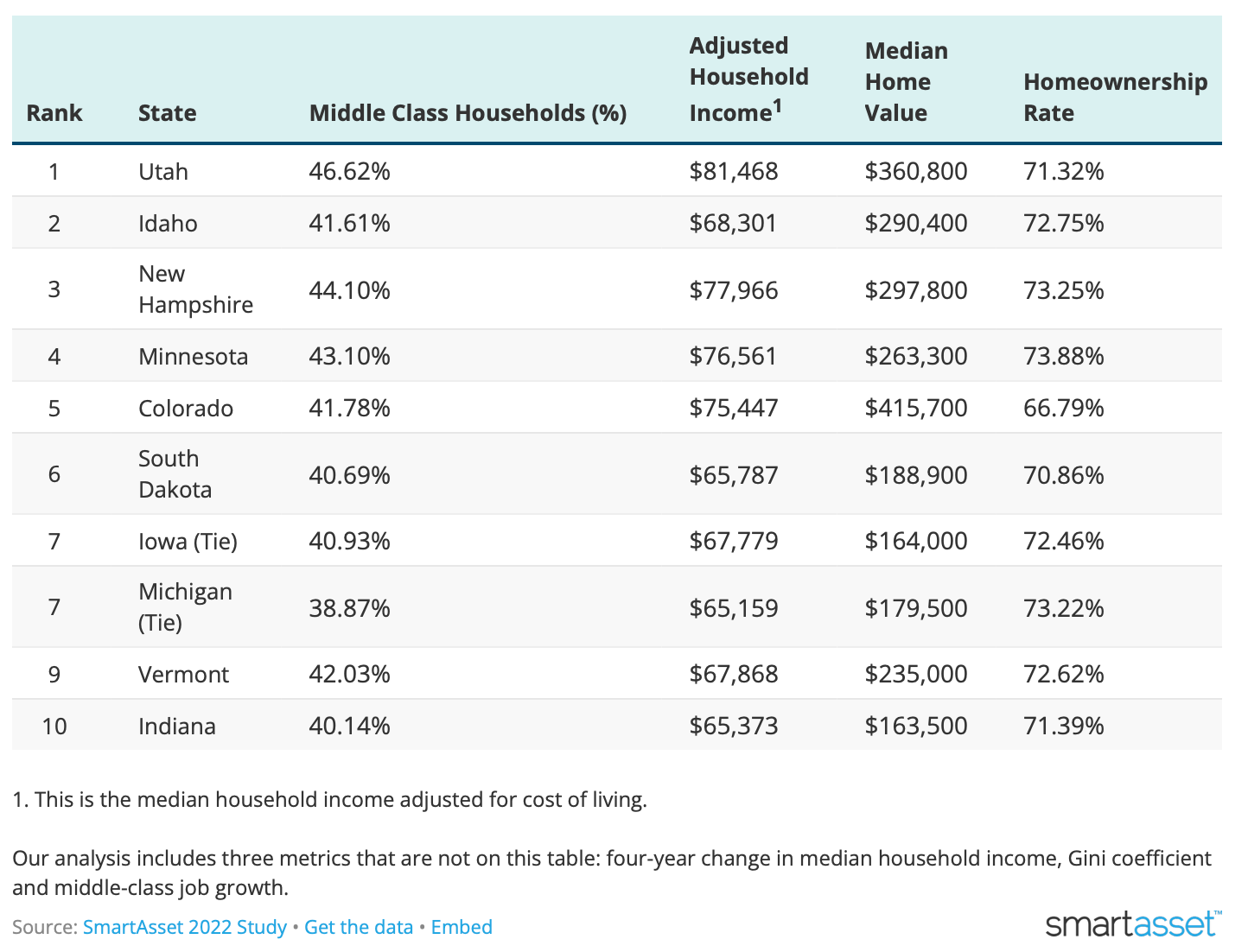
SmartAsset, a personal finance website and resource, compared the 50 states and the District of Columbia across seven metrics, including the percentage of households in the middle class, median household income adjusted for cost of living, median home values, homeownership rates, and more.

Given these factors, Utah and Idaho topped the list, offering more equitable income distribution and strong homeownership rates for the middle class, according to the study.

The following 10 states benefit the middle class the most by those criteria, according to SmartAsset’s study.

Chart listing cities where middle class can live comfortably

Source: “Best States for the Middle Class—2022 Edition,” Smartasset (April 26, 2022)

©National Association of REALTORS®
Reprinted with permission